e
--------------------------------------------
American miniatures added to the Artists and Ancestors collection since January 2026 include those below; More items may be amended, and/or added, during 2026.
Visitors to this website, are welcome to offer comments, especially with suggested attributions. Helpful comments can be added to this post, or sent by email.
----------------------------------------


This miniature was offered a a "British miniature", but in being purchased, it was the opinion of this collector it was more likely an American miniature, painted c. 1770-80, which was later rehoused in imported British casework of around 1800. In the Met catalogue, there are similar rehoused examples, of smaller miniatures, rehoused in larger case-work, including on page 63, one by Nathaniel Hancock.
The miniature here, (ds 1526) is possibly by Hancock, but it also has similarities with miniatures of c.1775-80, painted by Charles Willson Peale. It has stronger colouring than most CWP miniatures, which often have a more blue colouring, due to fading and a fugitive red pigment, but may possibly have been re-touched at the time it was rehoused. Another, less likely artist is John Ramage, as his miniatures are more usually painted with the sitter in a left-facing profile.
Relevant in attributing early American miniatures is the sight size, this one being 32mm x 27mm. That size is identical to a 1769 self-portrait by John Singleton Copley, in the Met collection. The pose is also similar to that self-portrait, and to a Copley miniature of Moses Gill, painted c.1759. The miniature also appears to have similar "gold-type" trim, as depicted in the self-portrait, also that of Gill, and another of Jeremiah Lee, painted by Copley in 1769. Copley left for London in 1775, so it is faintly possible he painted this in London, and the work was a transitory piece bridging the "modest school" size of miniature, placed directly into the mew fashion for larger casework. Thus, it is possible the artist was Copley, but confirmation will need the opinion of someone more knowledgeable than this collector.
Miniatures by CWP, of a similar size, and in similar pose, and painted c.1776, are on pages 34-36 of the Met catalogue. Until a clearer opinion surfaces, this miniature is attributed as a possible Charles William Peale.
--------------------------
Next is an American miniature, which after arrival, has been attributed to Anson Dickinson (1779-1852), it being in a typical red case of around 1835, There are multiple similar miniatures in Anson Dickinson, the Celebrated Miniature Painter, 1779-1852, Connecticut Historical Society, by Mona Leithiser Dearborn, and in the Met.catalogue, pages 100-104.
There are other examples by Anson Dickinson elsewhere in this Artists and Ancestors collection. ds 1531.


------------------------------------------------
This next miniature is also believed to be American, probably from the Boston area, judging by the painted eglomise decoration on the border framing. The artist is less certain, but it may be by Daniel Dickinson (1795-1977), see the examples on pages 140-141 of the Met catalogue. ds 1532.
The reverse has a hard to read note, needing more research, but appearing to read;
"Nicholas Fischer, son of Johann Seigfried. Fischer of Seliganne, Dobre (?) Bova set (?), Nauteo 1719 (?)."


---------------------
Another American miniature is more firmly attributed to Charles Willson Peale (1741-1827) ds 1534. The miniature, of 36mm x 30mm, is still in its original case, and has the typical blue toning of many CWP miniatures, with the reverse having a short, stuck on, note reading; "Capt. Loring RN. Mary Macneal of Ugadale.".
The previous owner, did not know the artist, and had assumed the miniature was a portrait of Admiral Sir John Wentworth Loring, KCB, KCH (13 October 1775 – 29 July 1852) a Royal Navy officer of the early nineteenth century, best known for his service in the Napoleonic Wars as a frigate commander. Born in the Thirteen Colonies at the outbreak of the American War of Independence, Loring's family fled to Britain and he subsequently joined the Royal Navy aged 13. In 1793, aged 17, Loring was badly wounded in combat at the start of the French Revolutionary Wars. He subsequently served throughout the following 23 years of warfare between Britain and France, and eventually became a full admiral. (Wikipedia)
John Wentworth Loring was born in October 1775 at the start of the American War of Independence to Joshua Loring, High Sheriff of Massachusetts. John's grandfather, Joshua Loring, had served in the navy in the Seven Years' War, commanding a squadron on the Great Lakes. The Loring family were Loyalists, and were ultimately forced to flee to Britain. In 1789, 13-year-old John Loring joined the Royal Navy, serving in HMS Salisbury before joining HMS Victory at the outbreak of the French Revolutionary Wars. (Wikipedia) See;
Royal Naval Biography/Loring, John Wentworth
For comparative purposes, there is another CWP miniature of Colonel Pope in the collection, in original case, and the same blue toning. There is an apparent small paint loss on his shoulder, to represent where his Colonel's epaulette was positioned, perhaps in gold, which may have since fallen off. ds 1495

 |
| Joshua Loring (1716-81) |

However, this collector doubted the portrait was of John Wentworth Loring, as it appeared to be painted c.1775-80, when John Wentworth Loring would have been aged only 5.
Instead, before purchasing for this collection, the note on the reverse was researched online, leading to this collector's belief the miniature actually depicts Commodore/Captain Joshua Loring (1716-81), the grandfather of Admiral John Wentworth Loring.
A portrait of Commodore Joshua Loring Sr. wearing a navy uniform, and wearing a bag wig, has obvious similarity with the CWP miniature. That portrait of Commodore Joshua Loring, at Jamaica Plain by Way of London — is displayed by the Jamaica Plain Historical Society.

See;
Commodore Joshua Loring, Jamaica Plain by Way of London — Jamaica ...
 |
| Joshua Loring Jr. (1744-89) |
There is a long Wikipedia reference to Joshua Loring Sr. which is helpful, but is unfortunately, and mistakenly, illustrated with a portrait of his son, Joshua Loring Jr. (1744-89), which depicts Joshua Loring Jr. wearing a red British army uniform, as Commissary General and per the description below,
Joshua Loring - Wikipedia
Whereas Joshua Loring Sr. was in the Royal Navy and so wore a blue uniform. The reference includes;Loring's eldest son, Joshua Loring, Jr., served as high-sheriff in Suffolk County, Massachusetts[ and was Commissary General of American prisoners-of-war in New York from 1777 until 1783. Together with William Cunningham, he was held responsible for the deaths from starvation and disease of thousands of Americans held prisoner on ships moored in New York Harbor. "[B]ut it is not easy to ascertain the truth, or to determine his personal responsibility in the treatment of prisoners." He was discharged from his office on the grounds of corruption and departed for England, where he died in 1789. Joshua Loring, Jr's son, John Wentworth Loring, served in the Royal Navy and rose to the rank of admiral."
A popular story recounts that, asked by an old friend what he would do when faced by a choice between remaining loyal and supporting the popular spirit of revolt, Joshua Loring Sr. replied "I have always eaten the King's bread, and always intend to."
The Loring family tree shows the connection, via the note on the reverse, between Joshua Loring Sr. and Mary Macneal of Ugadale. An abbreviation of the descendants in the Joshua Loring family tree at;
Joshua Loring (1716-1781) - WikiTree
includes one of his sons, John Loring;
- Mary Eliza (Loring) MacNeal (29 May 1802 - 25 Dec 1861) m. George MacNeal (abt 1793 - 23 Feb 1861) on 26 Dec 1821.
- Hector MacNeal (10 Jul 1822 - 02 Oct 1905) m. Constance Glencairn Campbell (16 Jul 1839 - 02 Jan 1912) on 27 Mar 1862.
- Mary Henrietta (MacNeal) Greenlees (20 Feb 1871 - 1917) m. Daniel Colville Greenlees (05 Mar 1869 - 11 Mar 1931) on 1896.
Hence the note on reverse of the CWP miniature "Capt. Loring RN. Mary Macneal of Ugadale.".refers to a granddaughter of Joshua Loring Sr.: Mary Eliza (Loring) Macneal, marrying George Macneal on 26 December 1821. The FindaGrave link for George Macneal, Esq. (1793-1861), of Ugadale, confirms Ugadale as his home, and his 1821 marriage to Mary Eliza Loring Macneal (1802-61);
George MacNeal (1793-1861) - Memorials

There are multiple Internet links to the home built by Joshua Loring Sr. These include;
History - The House
Slavery at the Loring Greenough House
A partial history reads;
The history of the Loring Greenough House begins in 1760 when Joshua Loring, a commodore in the English Colonial naval forces, constructed the large four-square frame residence in the historic center of Jamaica Plain. An outstanding example of Georgian Colonial architecture, the House was the hub of a large and actively developed farm that was Loring’s chief interest following his retirement from military service. His life as a distinguished member of the Colonial gentry came to an abrupt end with the bitter factionalism of the incipient Revolution. He fled the House in August 1774, for the greater security of Boston. He and his family permanently left Boston for England in 1776.
As there seems no reason to doubt the provenance outlined above, a genuine email attempt was recently made, to acquaint the Loring Greenough House, with this new discovery of a CWP miniature of Joshua Loring Sr. with the offer that they would be welcome to freely add the CWP image of Joshua Loring Sr. to their website if they so wished.
But, no reply, nor any acknowledgement, was received from the managers of Loring Greenough House.
-----------------------------------------------
Another American miniature of a young man and recently acquired is dated around 1820-25. The portrait appears painted by an untrained hand. The artist is not immediately obvious, but there seem two possibilities; ds 1536.
- George Loring Brown (1814-89) where the noses, pose, and profile are similar to two miniatures in the Worcester Art Museum catalogue, p.42-43. Presumably, Gorge Loring Brown was related to Joshua Loring in some way? The G L Brown miniatures seem a close match, being in an untrained, almost primitive style.
- Samuel F. B. Morse (1791-1872) where there is a young man in a similar pose on p. 129 of the Met catalogue.

-----------------
As a change from previous male sitters, an American addition is a well-dressed young lady; ds 1537

 |
| Metropolitan Museum |

Although, unusually, being painted on paper, as most miniatures are on ivory, the miniature is now attributed to William P Sheys (active 1813-23). Her ruff collar is typical of c.1820.
In size, profile, pose, and detail it is very similar to the William P Sheys portrait of a similar young lady on page 128 of the Met catalogue. The case is a typical, tired, red case of around 1820-40.
--------------------------------------------
The next American miniature is also of an attractive young lady wearing a black dress, in a battered, but also typical red case; ds 1551. She was likely painted around 1830-35, and there are multiple other examples in this collection of young ladies wearing similar black dresses from c.1830-35; So many that the iconic, "the little black dress", usually attributed to a 20C origin, was perhaps merely copying the"little black dresses" of c. 1830-35.
There are multiple similar portrait of young ladies in black dresses, elsewhere in this Artists and Ancestors collection. ds 1531. No artist attribution has yet been made, but should be possible with some more research. One possibility is Christopher Martin Greiner.
However, a kind visitor has observed stylistic similarities with a miniature by Daniel F. Ames (1803-86), on page 158 of the Met catalogue. That suggestion is accepted, and hence now regarded as an attribution; that is, until any better idea emerges.


---------------------------------------------
With a little embarrassment, here are two modern American miniatures, of c.1970-80; ds 1540

On of them is noted on the reverse as "a wax miniature by Aileen". They are small wax portraits of George and Martha Washington. What is unusual, is that the detailed wax heads and clothes, are embellished or decorated, with the addition of actual fabric and lace trimmings.
Although they may not properly merit inclusion in a collection of American miniatures, they were acquired as "space fillers" instead of seeking out actual miniatures by Mary Way (1769-1833). Miniatures by her, are very rare, and highly valued, so unlikely for examples to ever be acquired for this collection. The Met catalogue, p.76, describes her work;
She made miniatures in watercolor on paper as well as "dressed" miniatures-collages of cut-paper watercolor profiles with costumes made from cloth, braid, lace, and other trimmings, all mounted on a fabric background."
Thus, these wax heads of George and Martha Washington, with lace and other trimmings are "space-fillers", as an approximation of the miniatures by Mary Way.
---------------------------------------
A more typical American 19C miniature, is this one of an elegant, but unknown, young man. Unusually, for miniatures of this period, the case is complete. ds 1557. The miniature dates to around 1830-35. The casework of ds 1557 is very plain, compared to the next example below, ds 1559a. That change to a plainer case, was a result of cost, partially due to the casework cost, but more likely, due to increased market competition from other artists, who were offering a lower overall cost.


The case has not been opened, seeking a signature, as the bezel seems firmly in place. However, the portrait is comparable in style and date, to works by John Wood Dodge and Moses B Russell, both of whom normally included details on the backing paper inside the case.
Works of similar quality by J W Dodge, and dating around 1830-40, are on pages 185-189 of the Met catalogue. With similar works by M B Russell on pages 193-194 of the Met catalogue.
There are multiple similar portraits of young men or of ladies, by J W Dodge or M B Russell, elsewhere in this Artists and Ancestors collection
----------------------------------------------
More research was needed on foliate or guilloche type milled American miniature casework, which had, unfortunately, lain as an unresolved question for this collector. These pieces are often characterised by carved borders, resembling leaves, with considerable.variation in the examples of milled edges. Which then tends to imply the casework was bespoke, i.e. made to fit the size of each individual ivory plaque, and decorated with a milled bezel to the miniature artist's specifications.
However, a kind visitor has since made me aware of an example of a milling machine owned by the Pulmier Foundation, which is described by the Foundation as a rosette machine. The Foundation provides some history. In the early 16th century turning became a passion of expression for kings and queens and soon the rose engine lathe was invented. Aided by their court turners they pursued perfection, an impossible goal, as an expression of their core beliefs.

L'art de tourner, ou de faire en perfection toutes sortes ...
Published in 1701 by Louis XIV, Plumier’s book would stand as the sole comprehensive treatise on the subject for over 80 years. The importance of the book cannot be overstated. Recognizing this, Peter the Great had it translated into Dutch and Russian. Charles Plumier’s passion was to educate, and The Plumier Foundation shares that passion and has taken up the charge in the 21st century. See;
Plumier: Home
As can be seen in the photograph, the milling machine has a row of various and interchangeable cutting wheels. Presumably the operator had a range of samples for the artist to select from; and the operator was able to select one or more jigs (mechanical devices designed to hold and locate a component during machining), and mill a suitable pinchbeck (alloy of zinc and copper, used as imitation gold) rod to the desired length and design.


The above, newly added American miniature of an unknown man, 52mm x 50mm, ds 1559a, is an excellent example of foliate or guilloche milling. It is unsigned, and the rear glass is cracked, but that is regarded as a minor deficiency. As can be seen, at an earlier stage it was modified to wear as a broach, perhaps by a widow, but that fitting was later removed. The long, full, sideburns, and white stock, suggest a date of around 1820-25. The case has not been opened, seeking a signature, as the bezel seems firmly in place
Before its arrival, it was thought likely to be by Thomas Edwards (1795-1869) who worked in Boston, and mostly painted landscapes. However, on arrival, a closer examination has led to an attribution to George Catlin (1796-1872), based upon a comparison with these two Catlin miniatures owned by the Metropolitan Museum. The bust pose, plain background, foliate casework on the second, and place on the ivory, are very similar. Catlin originally worked in Philadelphia, but in 1827 moved to New York.
In American Portrait Miniatures, page 11, Lori Zabar, notes, such cases appeared first in Philadelphia; and such a Philadelphia location aids in the above George Catlin attribution.
 |
| Met Museum - George Catlin |
 |
| Met Museum - George Catlin |
Although most miniature portraits with casework with foliate/guilloche bezels, were oval in shape, the milling and bending of straight pieces of rod, did enable other formats to be formed and assembled. A rectangular bezel, not depicted here, is depicted in the Connecticut Historical Bulletin for October 1964; where page 129 includes a miniature portrait of Jabez William Huntington, with a rectangular foliate bezel.
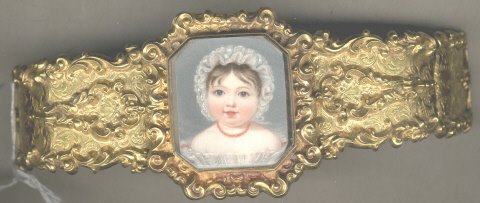 Zabar adds on page 21, "A similar style of locket popular at the time in Scotland probably served as the source of the design." This collection includes various British miniatures in similar cases. An ornate Scottish example, is a miniature portrait by William Douglas, set in a bracelet, and believed to depict his daughter Charlotte Douglas.
------------------------------------------
A benefit of having multiple American miniatures, is an ability, to try and group works by a single artist, and thereby improve the chances of an artist attribution. Acquired along with ds 1559a above, is this miniature of a young man ds 1559b. He is shown alongside two other miniatures in the collection, ds 914 and 549, supporting a strong opinion that all three are by the same, but still unattributed, artist.
 |
| ds 1559b |
All three miniatures, are of similar bust size, but with relatively small heads. They are all wearing a black stock, and have similar. but different foliate bezels.The foliate detail on the reverse of ds 1559b, although different to ds 1559a, likely required different jigs on a rosette machine. The bezel casework of all three is smaller than normal, with overall dimensions of ds 549, at 60mm x 48mm, ds 914, at 45mm x 37mm, and ds 1559b at 50mm x 42mm.
A possible artist is William Lewis.(1788->1838), although his works are often of slightly better quality..Another artist could be Samuel F. B .Morse (1791-1872).
 |
| ds 549 |
| ds 914 |

----------------------------------------------
This next miniature, ds 1559c, would not normally have been acquired as a separate item, but in this instance it was part of the lot including ds 1559a and ds 1559b, as above. 
It is 36mm x 30mm and in a gold filled case, with a rear window, which is empty. It is more likely American, than British, and an early example of a hand-coloured photo;and dates to the early years of the 20C, 1905-20..
The case work previously had a hinged pin on the rear, and is of uncertain age; but possibly pre-dates the age of the miniature, perhaps by decades. The casework may be suitable for re-use, with a different miniature.


------------------------------------------------
This fine American miniature, ds 1568, was acquired along with a similar quality piece, (ds 1569 as below).. It is 63mm x 53mm and in a foliate case, which has a dent on the rear, but is complete with rear bezel, glass, and hair. Foliate cased miniatures, which are complete, are increasingly hard to find..


A close-up gives a better idea of the superior quality. The sitter in the miniature is unidentified, and the miniature unsigned. Foliate type cases are more often associated with Philadelphia or Boston, which suggests an artist from that area.
A possibility is Henry William (1787-1830) who worked with William Doyle (1769-1828), before setting up separately. Doyle has been excluded, as his sitters normally face to the viewer's right. Benjamin Trott has been excluded, as he normally had a plain background. Joseph Wood, also seems unlikely as he usually painted sitters from slightly further away, so the sitter's head would seem smaller. Anson Dickinson and Robert Field have also been excluded. Also discounted is Nathaniel Rogers, who painted in a very distinctive manner. The Peale family also seem unlikely.
----------------------------------------
This American miniature, ds 1569, is 62mm x 48mm, and was acquired from the same source as ds 1568 above. It is in good condition, although the reverse glass is missing.


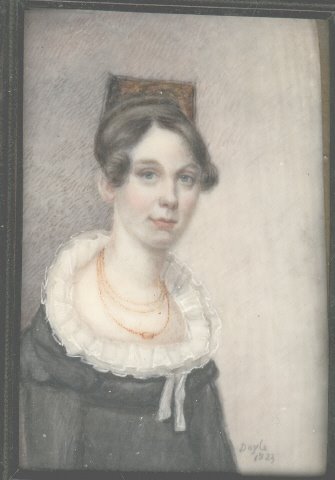
It is faintly signed at around 4 o'clock, Doyle, for William Massey Stroud Doyle (1769–1828), a portrait painter and museum proprietor in Boston, Massachusetts.

Olympia then offered them again on 13 May 3026, with a lower estimate of GBP200-300. They were purchased by a dealer for GBP200, plus Buyer's Premuim.
That buyer next offered them on Ebay UK, where this collector was fortunate enough to notice them, and was then able to bid successfully.
If there is any lesson from the above "journey", it seems that the markets for British, American, and European miniature portraits are, generally, quite distinct.
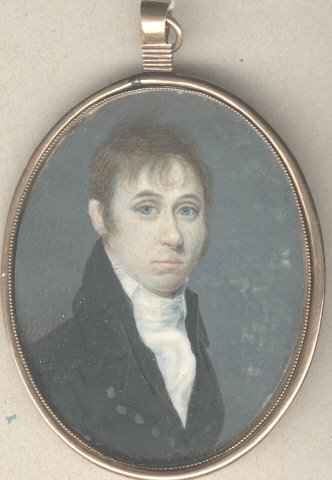
There are several other William Doyle miniatures in this collection, his style being quite distinctive. This young lady, ds 1048, is signed Doyle, 1823. The man, ds 635, is unsigned but is in distinctive Doyle style, with the sitter placed slightly left of centre..
--------------------------
The next pair of miniature portraits are a single artist, and are unusual, in that they have been re-framed, probably in the 1970's, into a modern setting, with reverses of mid 20C fabric, ds 1560 and ds 1561. Such fabric reverses were sometimes used in the early 20C as backing for decorative miniatures.
That of the older lady, at 65mm x 51mm, is further unusual, in that she has been modified. It appears the original miniature was 55mm x 34mm, but whilst being re-framed, it was expanded in size by the addition of painted ivory strips at each side, and at the foot: to balance up the size of the miniature: in order to better match the size of the modern frame, and the portrait of the other sitter, in a marginally narrower frame, 65mm x 48mm. Thus, the parallel vertical lines, are not cracks, but where the outer pieces of ivory were abutted, and then painted sympathetically with columns, and specially march the lace on the collar of her dress. This collector is not aware of other early 19C American miniatures being "expanded" in a similar manner.
As explained below, the older lady is deduced to be Bathsheba Smith (1770-1835) (painted pre 1835) (so aged about 50), and the younger one Ellen Chase Sedgwick (1812-1846) (painted c. 1835-46).
 |
| Bathsheba Smith (1770-1835) |

 |
| Ellen Chase Sedgwick (1812-1846) |

Without the original 10C framing, it is harder to make an attribution to an artist, but stylistically, the pair are believed to be painted by Sarah Goodridge.(1788-1842). Sitters in Goodridge miniatures often tend to have a stern, intense, and focused look, as if frozen in time.
It has been possible to deduce the identities of the two sitters, as they appear to be mother and daughter. For the benefit of family history researchers, full details are here, including some related portraits.
At auction they were similarly described, e.g. "Description - A finely detailed antique portrait miniature on paper* depicting a young woman in early 19th-century dress, shown with a delicately styled coiffure and lace-trimmed gown. Executed in soft, naturalistic tones, the portrait reflects the elegance and refinement of the Federal/Regency period, with careful attention to facial features and period fashion. This miniature is part of a collection associated with the Sanford/Tracy family, founders of the historic Sedgwick Farms in Syracuse, New York, adding notable historical and regional interest. The piece is housed in a simple gilt frame and presents attractively, with age-appropriate wear consistent with its period. From a group of related family portraits; please see additional listings for companion examples. Measures: 2-1/4” x 2-7/8”." [*a mistake, they were not on paper]
Several adjacent lots (purchased by others) included; At the same auction was another miniature (not bought), probably from c.1880-1900, which was described as;
"Description - An exceptional pair of antique portrait miniatures on porcelain depicting Ellen Sedgwick Tracy and her daughter, Sally Tracy. The larger oval portrait portrays Mrs. Tracy in profile, elegantly dressed in a rich red gown, and a necklace with her daughter's portrait, (also included in this lot). Refined detailing on both portraits. while the smaller companion portrait captures her young daughter with soft, lifelike expression. Both are finely hand-painted with delicate shading and attention to detail, characteristic of 19th-century porcelain miniatures. These portraits are part of a significant family collection connected to the Sanford/Tracy family, founders of the historic Sedgwick Farms in Syracuse, New York, offering strong historical and regional importance. Housed in simple gilt frames, the pair presents beautifully together and provides a rare, personal glimpse into an early American family lineage. Measurements: Mother: 2-3/4" W x 4" H Child: 1-1/2" W x 2" H. A related miniature at the auction, but not purchased, in a similar frame, was of an older gentleman.
 |
| Ellen Amelia Tracy (1841-1924). |
 |
| Stephen Sedgwick (1783-1830). |
Thus, the two miniatures are mother and daughter,who appear to be mother and grandmother of Ellen Sedgwick Tracy, and her daughter, Sally Tracy. And also closely related to the older gentleman, who is likely husband of the grandmother..
After looking at a Segwick family tree, it is believed the older lady is Bathsheba Smith (1770-1835) (painted pre 1835) (say aged about 50) and the younger is Ellen Chase Sedgwick (1812-1846) (painted c. 1835-46), (so aged about 30-35). With Ellen Amelia Tracy (1841-1924). There seem two options for the older man, Charles B Sedgwick (1815-1883) or Stephen Sedgwick (1783-1830), husband of Bethshada Smith. The collar in the miniature of the man looks to be about 1820-30, and so seems too young for Charles, and thus, if Stephen, he would then be aged about 45-50.
-----------------------------
The next unsigned miniature of a young lady in black dress was purchased from America, and has a Los Angeles framer's label. The attractive sitter is very well painted, and the style dates to around the mid 19C. It is 100mm x 72mm and deftly painted on a porcelain plaque about 5mm thick. The detail being better and clearer, than appears in the images
Porcelain is a very unusual medium for American portraits, and hence it was more likely painted in Germany, where there is a history of painting on porcelain. Nevertheless, it was acquired for the collection, as an interesting example of a variation of technique.


----------------------------
-------------------------------
There are several other American miniatures, still in transit.


No comments:
Post a Comment